
01MVPs for Startups
Custom MVP Software Development in New York
Custom MVP software development helps New York startups test a defined customer need before investing in a broad product. We prioritize one useful journey, build in two-week sprints with demos and plan a first release that can grow. An MVP starts from $10,000 with 100% code ownership.
02Custom Software Development for Startups: What an MVP Includes
Custom Software Development for Startups: What an MVP Includes
A minimum viable product is the smallest useful version of a product, not a broken version of a large platform. Someone in the intended audience should be able to complete the main task and understand the value. Define that task and the evidence you want from its use before choosing screens or technology.
The launch scope should include the basics needed to operate responsibly: appropriate sign-in, permissions, error handling and a practical way for the team to manage users. Those needs do not disappear because the product is early. The level of engineering should match the risks and expected use rather than a vague promise to fix everything later.
Leave out work that does not test the main assumption, such as a second platform, advanced reporting or elaborate customization nobody has requested. Some manual operations can be appropriate while volume is low, provided they are safe and clearly owned. Make the trade-offs visible so stakeholders know what has deliberately been postponed.
03Custom MVP Software Development Services in 3–4 Months
Custom MVP Software Development Services in 3–4 Months
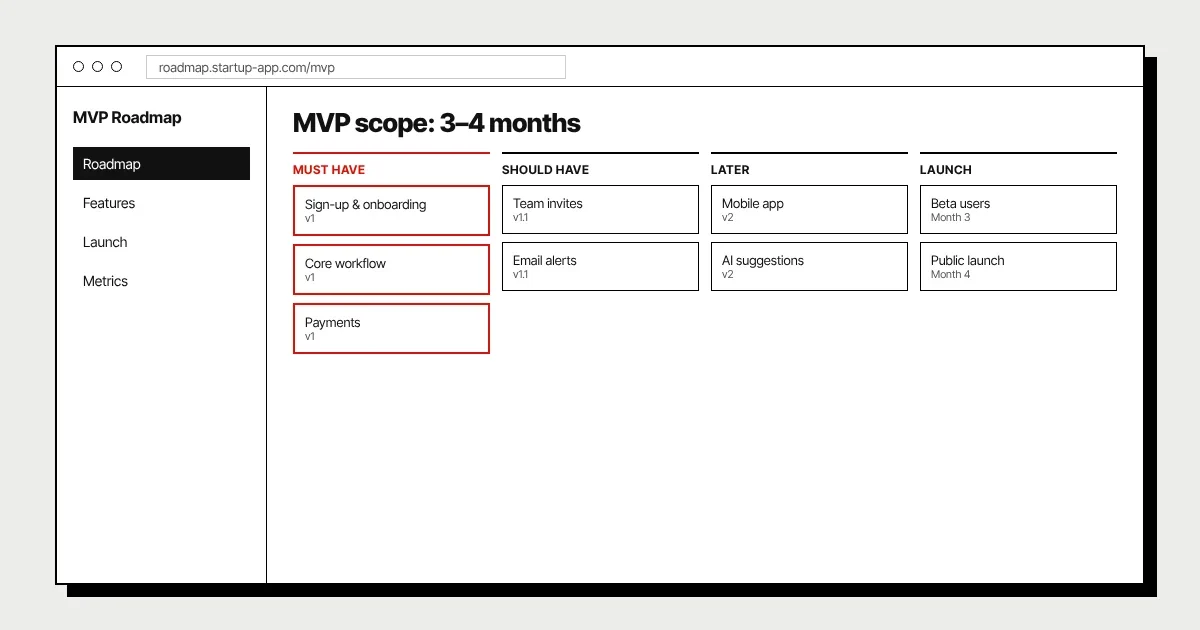
The typical 3–4 month plan depends on a bounded scope and timely founder decisions. External approvals, difficult integrations and requirements added mid-project can change delivery. We agree the first release during discovery and show working progress through two-week sprint demos.
- 01Define the product hypothesisIdentify the user, problem and useful outcome, then list the assumptions the first version must test. Review competing commercial options and the systems the product needs to connect to. Agree launch acceptance criteria before the fixed scope becomes an implementation commitment.
- 02Design the core journeyPrototype onboarding and the main action with realistic content and errors. Review the journey with the decision-maker before engineering it. Keep optional screens out of the way so the first useful experience stays understandable.
- 03Build and reviewImplement the product in two-week sprints, with demos of complete pieces of the journey. Review decisions and dependencies as they arise. Add necessary operation and administration tools alongside customer-facing features rather than leaving them to the final week.
- 04Test and launchCheck access, payments or other business rules against the agreed scope and prepare deployment. Confirm production account ownership and a plan for collecting feedback. Launch should create a usable product the business can run, not just a developer demonstration.
04Choosing Features: Must-Have vs Later
Choosing Features: Must-Have vs Later
A feature is essential when the target user cannot complete the core task without it, or when leaving it out creates an unacceptable risk. Trace the journey from the user's first visit to the useful result. Challenge additions that sound attractive but do not change whether that journey succeeds.
Use a short decision record for each feature: the user problem, expected outcome, launch dependency and how you will measure its value. A founder dashboard may be useful, but it may not matter as much as a customer being able to submit and track the first request. This framework makes prioritization more concrete than simply labeling every idea high priority.
Keep a later backlog with reasons rather than deleting ideas altogether. When a stakeholder requests something new, compare it with the current launch goal and assess the cost or schedule effect. Custom software development for startups works better when ‘minimum’ is a decision you can defend, not a budget constraint that everyone quietly ignores.
05Tech Choices That Scale
Tech Choices That Scale
Scaling starts with a coherent data model, clear permissions and a maintainable release process. It does not require building every possible infrastructure component before users arrive. Choose enough structure to extend the core journey without paying for complexity the first version cannot use.
Our existing stack includes React, Node.js, Python, Flutter, React Native, PostgreSQL and cloud services such as AWS and Azure. The final choice depends on the platform, team and integrations, not a promise that one stack fits every startup. Explain the trade-offs and document deployment so the business can make informed future decisions.
Define expected early usage and the events that would justify additional work: slower queries, growing queues or a new market with different requirements. Test practical workloads and monitor the product after launch. Reusing the codebase is a direction supported by maintainability, not a guarantee that no component will ever need to change.
06Preparing for Investors
Preparing for Investors
A useful investor demo shows a real user solving a real problem. Use a stable demonstration flow with representative data and make clear what is working software versus planned functionality. Do not present a prototype, sample account or manually assisted process as evidence of adoption that has not happened.
Metrics should match the product hypothesis: activation, repeat use, task completion or another outcome that matters to the customer. Agree event definitions before collecting data, and distinguish product evidence from vanity numbers. A small amount of interpretable evidence is more useful than a dashboard full of unrelated totals.
Ownership and documentation matter when another team examines the product. You own 100% of the source code, repositories and credentials; dependencies and third-party licenses should be recorded separately. Development can prepare the product and demonstration, but it cannot promise funding, investor introductions or a particular valuation.
07After the MVP: Version 2
After the MVP: Version 2
Version two should respond to what the first release teaches you. Review where users stop, what they request repeatedly and which tasks still require unnecessary assistance. Separate a usability problem from a request for a new feature so the roadmap addresses the real source of friction.
Prioritize the work that supports the next measurable goal, whether that is retention, paid conversion or handling more transactions reliably. A second platform may now be justified, or the business may need improved administration before more customer features. Use the same visible backlog and sprint review process rather than treating launch as the end of planning.
Allow for dependency updates, monitoring and support while new development continues. Agree who investigates problems and which changes require a new scope or engagement. Your business retains control of the code and credentials, so future development is not locked to a single supplier.
08FAQ
Frequently Asked Questions
MVPs start at $10,000 USD for core features on one platform. The final scope, integrations and operational requirements determine the quote, which we send within 48 hours of a discovery call. Starting smaller means prioritizing a complete useful journey, not assuming every future product feature is included in the entry price.
09Related
10Contact
Let's build your software in New York
Book a free 30-minute call. We'll review your idea and give you an honest plan and estimate.
+1 718-883-7253Service area: Brooklyn, Queens & Manhattan, NYC
Hours: Open 24/7