
01Pricing
How Much Does Custom Software Development Cost in New York?
Custom software development cost depends on what the system must do, how much existing data it must handle and the risks it must manage. For New York businesses, SDO's USD starting prices are $10,000 for an MVP, $18,000 for a web or mobile app and $30,000 for an enterprise system. Compare the scope behind each figure, then budget for operating the product after release.
Starting Prices
MVP
From $10,000
3–4 months
Core features, one platform, launch-ready
Most common
Web or mobile app
From $18,000
4–5 months
Custom UX/UI, admin dashboard, integrations
Enterprise system
From $30,000
5–6+ months
Complex workflows, security & compliance, scale
Prices in USD. Final price depends on scope. You always get a fixed quote before we start.
Dedicated developer
From $3,500 per developer / month
Full-time, minimum 3 months
Project Cost Calculator
Pick a project type, then drag the features you need into your project. The estimate updates instantly and shows which pricing tier your scope reaches. Download it as a Word document to share with your team.
Step 1 · Project type
Step 2 · Platforms
Your first platform is included; each extra one adds its price.
Step 3 · Drag features into your project
- User accounts & loginSign up, sign in, password reset+$1,500
- Admin dashboardManage users, content and data+$2,500
- Payments & subscriptionsCards, invoices, recurring billing+$2,500
- Third-party integrationEach connected system (CRM, ERP, API)+$2,000
- Email & push notificationsAlerts, reminders, receipts+$1,000
- Real-time chatIn-app messaging between users+$3,000
- AI featuresAssistants, document reading, predictions+$5,000
- Reports & analyticsCharts, exports, KPI views+$2,500
- Roles & permissionsDifferent access per team+$2,000
- Maps & locationTracking, routes, geofences+$2,000
- File uploads & documentsUpload, preview, store files+$1,000
- Multiple languagesTranslated interface+$1,500
- Offline modeWorks without signal, syncs later+$2,500
- Security & complianceAudit logs, HIPAA/SOC 2 readiness+$6,000
- Data migrationMove data from an old system+$4,000
Your project
Drop features here, or tap + on any feature.
02What Drives Custom Software Development Pricing
What Drives Custom Software Development Pricing
A screen count is not a reliable estimate. Two applications with ten screens can differ greatly if one displays basic content and the other manages complex permissions, payments and synchronization with external systems. The estimate needs to reflect business rules, testing and deployment, not just visible design.
- 01ScopeMore roles, workflows and exceptions mean more implementation and testing. Define the first release by complete user journeys rather than a long list of disconnected features. A clear acceptance criterion helps distinguish necessary work from a nice-to-have change.
- 02IntegrationsAn accessible, documented API is different from a legacy system with incomplete records or restricted access. Budget for mapping fields, authentication, retries and reconciliation. Confirm sandbox access and vendor support before treating an integration as a small line item.
- 03PlatformsA browser app, iOS app and Android app each introduce delivery and testing work. Shared APIs and cross-platform code can reduce duplication, but devices and release channels still need attention. Build the platform your users need first, then extend based on evidence.
- 04DesignA repeatable internal workflow needs different design effort from a consumer product with onboarding, accessibility and many device layouts. Prototypes let stakeholders test the important interactions early. Settling those decisions before development avoids paying to rebuild finished screens.
- 05ComplianceSensitive data and regulated operations can require additional controls, documentation and review. Agree applicable requirements with your advisers and include them in scope before development. Assessments, specialist advice and external approvals may be separate costs rather than engineering deliverables. This is general information, not legal advice.
- 06TimelineA compressed deadline can require parallel work and more coordination without removing testing or review. Late stakeholder decisions and unavailable third-party access are also schedule risks. If the date cannot move, reduce the first release to the workflows that must be live.
03Typical Timelines
Typical Timelines
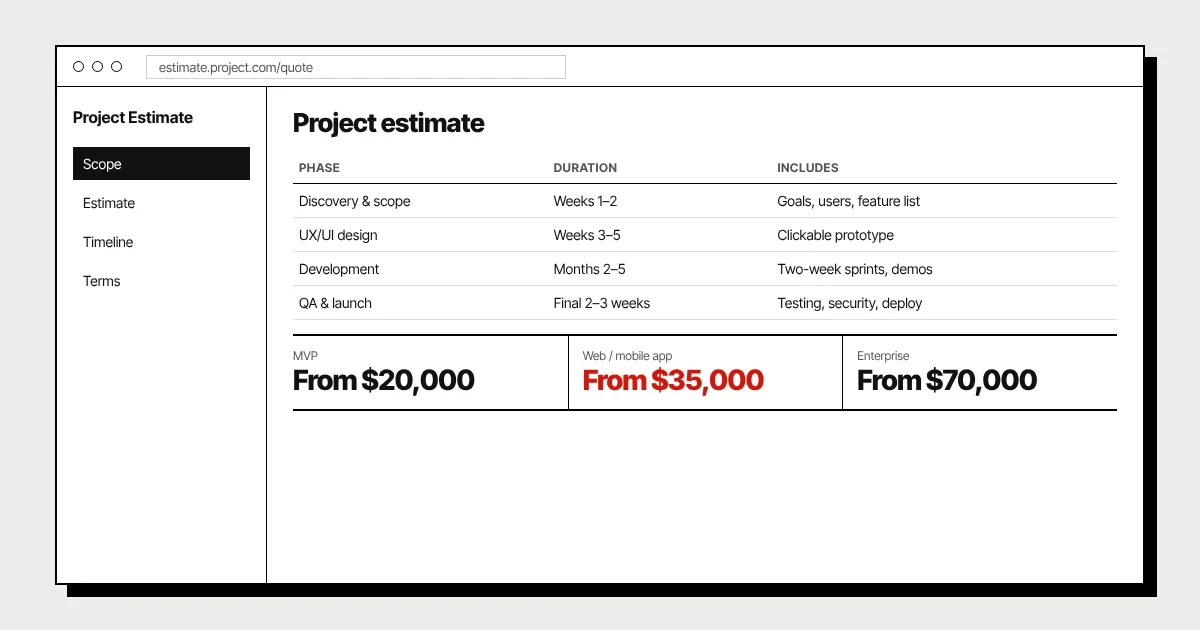
Most projects take 3–6 months, with larger enterprise systems able to run beyond six months. The phase ranges below describe a typical plan rather than milestones to add together mechanically: design, development and testing can overlap. The agreed release schedule depends on scope and timely access to people and systems.
- 01Discovery: about two weeksMap users, data, integrations and success measures; define the first release and its acceptance criteria. Identify the people who must approve the work and any external dependencies before committing to implementation.
- 02Design: about three weeksTurn the important journeys into UX/UI designs and a prototype. Review real scenarios, including errors and permissions, while changing a screen is still less expensive than changing production code.
- 03Development: about two to four monthsImplement the release in two-week sprints with demos. Review working journeys as they become available and keep new requirements visible. A prioritized backlog prevents optional additions from quietly displacing launch-critical work.
- 04QA and launch: final two to three weeksComplete release testing, prepare deployment and confirm handover. Data migration rehearsals, device testing and stakeholder acceptance may need extra time for complex systems. A staged rollout can reduce operational disruption.
04The Cost of Custom Software Development After Launch
The Cost of Custom Software Development After Launch
The build price is only one part of the cost of custom software development. Plan an operating budget before launch so a successful product does not become difficult to maintain. Each item below should have a named owner and a clear method for reviewing usage.
- 01Hosting and infrastructureCompute, databases, storage, backups and monitoring can change with traffic and data volume. Ask for the expected architecture and a usage-based budget, not a permanent fixed figure disconnected from growth. Keep production accounts under business control.
- 02MaintenanceOperating systems, dependencies and external APIs change even when your features do not. Allow for security updates, monitoring and bug investigation. Separate maintenance from new feature work so both can be prioritized rather than competing invisibly for the same budget.
- 03Third-party licenses and usageEmail, SMS, maps, payments and AI services may charge per use or by subscription. Track assumptions such as messages per customer and documents processed per month. These services can remain recurring costs even when you own the application code.
- 04App store fees and release workMobile distribution may involve developer account fees, store requirements and review cycles. Verify current charges directly with Apple and Google rather than relying on a stale estimate. Budget time for listing material, privacy disclosures and changes requested during review.
05Fixed Price vs Time & Materials
Fixed Price vs Time & Materials
Fixed price gives a defined scope a predictable development budget. It requires agreement on deliverables, acceptance criteria and assumptions before work begins. When a new integration or user role is added, assess the change openly rather than pretending the original scope has not changed.
Time and materials is useful when a technical investigation or evolving backlog cannot be priced responsibly as a complete outcome. Agree rates, reporting, approval limits and how the budget will be reviewed. More flexibility does not remove the need for priorities and an accountable product owner.
A dedicated developer is another way to plan sustained capacity: from $3,500 USD per developer per month, full-time, with a minimum three months. Capacity is not a promise of unlimited features. The work completed still depends on complexity, dependencies and decisions made during each sprint.
06How to Reduce Cost Without Cutting Quality
How to Reduce Cost Without Cutting Quality
Reduce scope before reducing safeguards. Choose one platform and one core journey for the first release, reuse appropriate existing services and postpone features whose value has not been tested. Keep the data model and code maintainable so the next release does not require a rebuild.
Provide realistic sample data, an available decision-maker and early access to third-party sandboxes. These inputs prevent engineers from guessing and then reworking finished behavior. Use prototypes and sprint demos to settle disagreements before they become expensive changes.
Write down what success looks like at launch and how you will measure it. A smaller system that solves a measurable problem is usually a better investment than a broad platform nobody adopts. An MVP can validate the most important assumptions before you fund the rest.
07How New York Rates Compare
How New York Rates Compare
Many New York agencies charge $120–$180 per hour, as a budgeting benchmark rather than a guaranteed market average. Hourly rates alone do not describe the total investment: confirm which roles, testing, project coordination and handover are included. A lower rate with more rework can cost more than a well-scoped engagement.
SDO quotes the defined project rather than asking you to infer the total from a headline hourly rate. Compare suppliers against the same deliverables and operating assumptions, including ownership of accounts and code. We do not publish a universal hourly rate or promise a particular percentage saving.
09FAQ
Pricing FAQs
You are paying for a system designed around your workflows, not a copy of a finished subscription product. Discovery, design, integrations, security, testing and deployment all require work beyond the visible screens. Cost increases with complex rules and uncertain dependencies, which is why narrowing the first release often saves more than simply negotiating an hourly rate.
10Related
11Contact
Let's build your software in New York
Book a free 30-minute call. We'll review your idea and give you an honest plan and estimate.
+1 718-883-7253Service area: Brooklyn, Queens & Manhattan, NYC
Hours: Open 24/7