
01Manufacturing
Custom Manufacturing Software Development in New York
Custom manufacturing software development connects shop-floor activity with the records used to plan, review and improve production. SDO serves New York manufacturers in Brooklyn, Queens and Manhattan, scoping production, inventory and quality workflows around actual operations. We begin with traceable records and accountable decisions rather than assume a new dashboard can fix an undefined process.
02Who This Is For
Who This Is For
A manufacturer tracking jobs manually may need clearer status, while another operation may need to connect an existing ERP with machine or quality records. Those needs should be assessed separately. Start with the work that cannot currently be followed reliably from plan to completion.
Include operators, supervisors, quality and planning staff when their decisions are affected. They can describe normal exceptions and the conditions under which a record is valid. A software specification based only on management reporting may miss the steps required to produce trustworthy information.
Custom industrial software development can extend useful existing systems rather than replace every tool. Review supported integrations and operational dependencies before choosing a broad transformation. A complete first workflow with clear ownership is more useful than a collection of modules nobody can safely adopt.
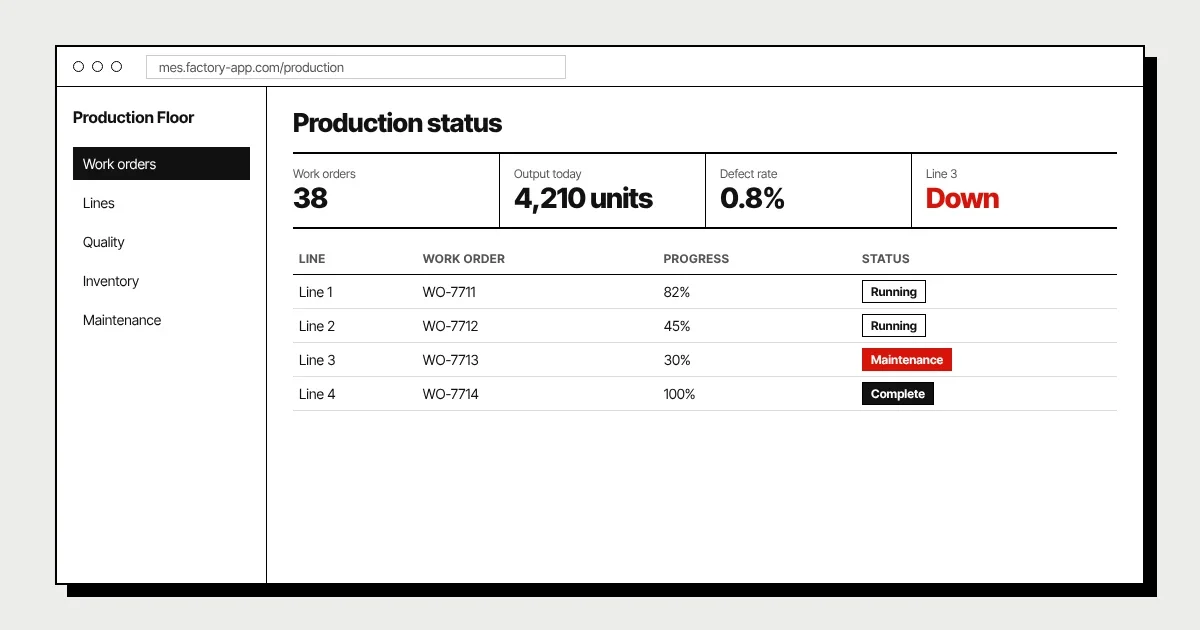
03Custom Industrial Software Development: Production Planning & MES
Custom Industrial Software Development: Production Planning & MES
- 01PlanningDefine jobs, resources and the constraints the operation actually uses to sequence work. Material availability, capacity and approval rules should be visible rather than implied. A schedule must have a controlled way to change when the underlying assumptions no longer hold.
- 02Execution recordsManufacturing execution workflows can record the agreed steps and status of a job. Identify who can confirm progress and what evidence is needed. A machine signal and an operator completion event may mean different things, so avoid merging them without clear business rules.
- 03ExceptionsRework, downtime and missing materials need accountable handling instead of a generic failed status. Record the reason, next action and relevant history. Useful exceptions help staff recover the workflow and let supervisors understand what actually happened.
- 04ReportingDefine metrics and their sources before building performance charts. Completed jobs, elapsed time and accepted output are not automatically equivalent measures. Reporting should preserve context rather than turn incomplete shop-floor records into precise-looking totals.
04Traceability, Quality and Inventory
Traceability, Quality and Inventory
Traceability begins with agreed identifiers and relationships among materials, batches, jobs and output. Decide what must be recorded at each step and how corrections remain understandable. A chain of records is only useful when operators can capture the information consistently under actual working conditions.
Quality workflows need approved checks, review responsibility and a response to nonconforming results. Preserve relevant observations and decisions without treating every result as a simple pass or fail. Requirements and acceptance criteria come from qualified operational owners, not invented software defaults or an unverified certification claim.
Inventory should reflect agreed movements, reservations and adjustments, with a history staff can explain. Units and locations need consistent meaning across production and purchasing. A stock dashboard cannot become authoritative merely because it updates quickly when the source transactions remain incomplete.
05Custom Software Development for Manufacturing Industry Data
Custom Software Development for Manufacturing Industry Data
Machine data depends on the hardware, supported protocols and vendor access. Assess representative devices and networking before promising universal connectivity or real-time information. Some integrations may require gateways or vendor cooperation outside the custom application itself.
Define timestamps, identifiers and what each message means for the business workflow. Handle retries, duplicates and gaps so a signal does not silently trigger an incorrect production update. An apparent reading can require interpretation before it is evidence of accepted output or a completed step.
Remote control and safety-critical actions are distinct from monitoring. Their feasibility and responsibilities need qualified engineering review, not a casual extension of a dashboard scope. The application should not bypass machine safeguards or imply responsibility for equipment behavior it has not been designed and assessed to control.
06Security and Operational Responsibilities
Security and Operational Responsibilities
Use role boundaries appropriate to operators, approvers and administrators, with protected actions enforced by the service. Record meaningful changes and limit unnecessary sensitive information in logs. Shop-floor device access and the network connecting it are part of the wider risk picture.
Define update and incident responsibilities alongside the software deployment. A stopped integration should be visible, and staff should know which workflow can continue safely without it. Business continuity cannot depend on one undocumented account or an unavailable developer.
Required records, retention and quality procedures depend on the actual products and operation. Confirm applicable standards and obligations with qualified owners before implementing them; no ISO or industry certification is implied by this page. Software can support approved controls without replacing assessment or operational governance. This is general information, not legal advice.
07How We Build Manufacturing Software
How We Build Manufacturing Software
Discovery follows a real job through planning, material use, execution and review, including normal exceptions. Identify the system of record and a complete first release before agreeing implementation. A fixed quote follows the free discovery call within 48 hours, with hardware and data access assumptions stated clearly.
Prototype the operator and supervisor tasks using representative conditions and records. Two-week sprints with demos show connected work rather than isolated reporting screens. Test unauthorized changes, duplicate messages and integration outages alongside the planned workflow.
Rehearse migration or cutover, train staff on tasks and exceptions, and release in agreed stages where practical. You own 100% of the custom code, repositories and credentials. Assign monitoring and support owners before the application becomes part of daily production, then use operational feedback to plan the next module or improvement.
08Related services
Related Services
09FAQ
Frequently Asked Questions
Planning and execution workflows can be scoped around the actual jobs, resources and approval rules in your operation. Define progress events and normal exceptions before implementation. The application should preserve traceable records and support operator decisions rather than assume a generic schedule or machine signal describes every manufacturing process correctly.
10Contact
Let's build your software in New York
Book a free 30-minute call. We'll review your idea and give you an honest plan and estimate.
+1 718-883-7253Service area: Brooklyn, Queens & Manhattan, NYC
Hours: Open 24/7