
01AI & Automation
Custom AI Software Development in New York
Custom AI software development starts with a task worth improving, not a model looking for a purpose. SDO helps New York businesses plan assistants, document workflows and AI features that fit their existing software. We serve Brooklyn, Queens and Manhattan, with discovery focused on measurable results, appropriate data access and a practical path from prototype to production.
02Practical AI Use Cases
Practical AI Use Cases
The useful question is where people repeatedly read, classify, retrieve or summarize information. Choose a bounded task with examples of a good result and a clear way to handle mistakes. A prototype should show whether the proposed approach helps that task before the business commits to a wider rollout.
- 01AssistantsAn assistant can help staff draft responses, navigate approved knowledge or collect information for a request. Give it a defined role and restrict the actions it may take. Consequential decisions should have an appropriate review step rather than granting a conversational interface unrestricted access to business operations.
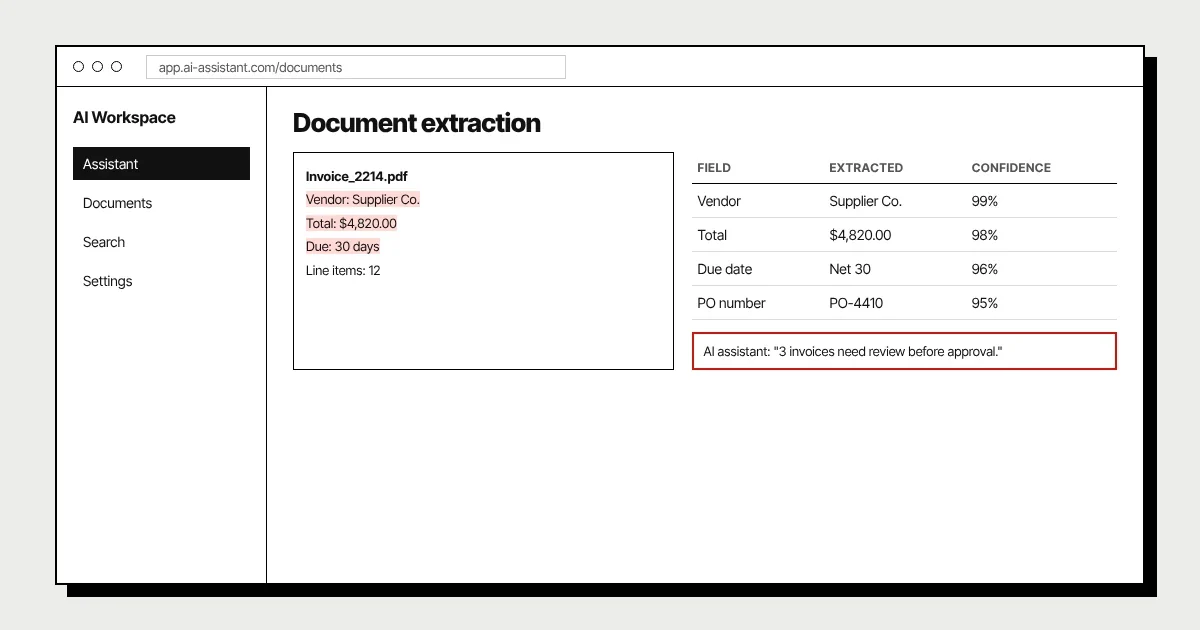
- 02Document extractionExtracting fields from invoices, forms or other documents can reduce repetitive entry. Test with realistic layouts, missing fields and low-quality scans, and compare results with verified records. Route uncertain or conflicting values to a reviewer instead of accepting every generated answer as a fact.
- 03Knowledge searchSearch can retrieve relevant passages from approved documents and show the source alongside an answer. Permissions must apply before information reaches the model, not just after an answer is displayed. Update or remove indexed material when the source changes so outdated instructions do not remain searchable indefinitely.
- 04ForecastingForecasting needs historical records that represent the outcome being predicted. Compare a proposed model with a simple baseline and test on data it has not seen. A forecast should communicate uncertainty and support a decision, not present a precise-looking number as a guaranteed future result.
03Custom Computer Vision Software Development
Custom Computer Vision Software Development
Custom computer vision software development can support inspection, classification or extracting information from images. Start with the actual cameras, lighting and conditions where the system will run. A demonstration on selected images does not prove reliability on a busy production line or in a changing outdoor environment.
Agree which objects or defects matter and how examples will be labeled. Include ambiguous images and cases the system should reject, then define how people review those exceptions. Missing a serious defect and flagging a harmless image have different costs, so accuracy alone may be the wrong measure.
Deployment planning also matters: an image-processing system may need to run on a device, through a local gateway or in the cloud. Connectivity, response time and image retention affect that choice. We assess feasibility with representative material before promising a particular detection capability or processing speed.
04AI Inside Your Existing Software
AI Inside Your Existing Software
AI is often more useful inside a workflow people already use than in a separate destination they must remember to visit. A CRM might offer a suggested summary; an operations system might propose extracted fields for confirmation. The surrounding application remains responsible for permissions, validation and recording the final action.
We review the existing API, data model and release process before scoping a connection. Specify whether the feature can read data, propose changes or execute approved actions, and keep those capabilities separate. A model-generated request must pass the same authorization and business rules as any other request.
Plan for provider outages, rate limits and changes in model behavior. Users need a sensible fallback, and administrators need visibility into failures and usage costs. Introduce the feature to a limited workflow first so its effect can be checked before broader adoption.
05Data Privacy & Security for AI
Data Privacy & Security for AI
Map what information is sent to each service, why it is needed and how long it is retained. Training use, logging and retention depend on the provider, product and contract; no universal privacy promise is safe. Verify those terms before confidential data is submitted and use redacted or synthetic examples where appropriate.
Apply least-privilege access to retrieval and tool actions, and keep private credentials out of prompts and browser code. Treat documents and user messages as untrusted input: they may contain instructions that should not override the application's rules. Record enough information to investigate failures without unnecessarily copying sensitive content into logs.
Regulated or personal information may require additional agreements, controls and specialist review. Your legal and security advisers should confirm applicable requirements and permitted processing before production deployment. Technical safeguards support that decision but do not replace it. This is general information, not legal advice.
06How We Deliver Custom AI ML Software Development Services
How We Deliver Custom AI ML Software Development Services
Custom AI ML software development services should separate experimentation from commitments about production performance. We define what the prototype must prove and what would make the project unsuitable. The first release needs both an evaluation plan and a person accountable for reviewing its impact.
- 01DiscoveryChoose the workflow, gather representative examples and establish the current baseline. Define failure costs, permissions and acceptable review effort. Identify whether retrieval, ordinary automation or a model is the simplest approach that meets the need.
- 02PrototypeTest the proposed approach on examples not used to tune it, including difficult cases. Compare outcomes and costs with the baseline. Record limitations openly so the decision to proceed is based on evidence rather than a polished demonstration.
- 03ProductionBuild the integration, review paths, monitoring and fallback into the application. Deliver in two-week sprints with demos, then evaluate behavior with actual users. Agree how changes to prompts, data or model versions will be tested after launch.
07What AI Can't Do
What AI Can't Do
A fluent response is not proof that an answer is correct. Models can omit context, fabricate details or follow misleading instructions embedded in source material. Design workflows to check the result, expose sources where useful and let a person intervene before an expensive or irreversible action.
AI cannot repair missing business definitions or make poor source data trustworthy by itself. If records disagree about a customer, stock level or outcome, the underlying process needs attention. Start by identifying authoritative data and decision rules instead of asking the model to guess between conflicting versions.
Neither a prototype nor a published benchmark guarantees results on your workload. Provider usage fees, human review time and monitoring belong in the operating budget. A custom AI software development company should be willing to recommend simpler software when a model adds uncertainty without improving the result.
08FAQ
Frequently Asked Questions
That depends on the selected provider, service tier, settings and agreement. We verify training-use and retention terms for the proposed deployment before confidential information is sent, rather than promise that every AI product behaves the same way. Limit the data shared, establish permitted use and involve your security or legal team where sensitive records are concerned.
09Related
10Contact
Let's build your software in New York
Book a free 30-minute call. We'll review your idea and give you an honest plan and estimate.
+1 718-883-7253Service area: Brooklyn, Queens & Manhattan, NYC
Hours: Open 24/7