
01Healthcare
Custom Healthcare Software Development in New York
Custom healthcare software development should make a clinical or administrative workflow easier without creating unnecessary exposure of patient information. SDO serves clinics, practices and health-tech startups in Brooklyn, Queens and Manhattan. We begin with users, data and operational responsibilities, then scope portals, telehealth and integrations around the systems and safeguards the organization actually needs.
02Who This Is For
Who This Is For
A practice may need better intake and scheduling while retaining its existing clinical record system. A health-tech founder may need a patient-facing product with a defined relationship to providers and sensitive data. Those are different projects, even if both are described as a healthcare app.
Clinical, administrative and technical stakeholders should help define the workflow. Identify who makes care decisions, who updates records and who responds when a request arrives outside normal operation. A patient interface cannot be designed responsibly without understanding the process behind it.
A custom healthcare software development company should assess whether configuration or an existing product can meet the requirement first. New software is justified when a meaningful gap remains and the organization can own its operation after launch. We do not replace clinical judgment or promise that an application alone establishes compliance.
03Common Problems
Common Problems
Follow a real task from patient request through staff action and completion. Include failed submissions, mismatched identities and urgent messages rather than only the ideal journey. That exercise identifies whether the main problem is software, data quality or a responsibility that has never been assigned.
- 01Repeated intake and disconnected recordsPatients and staff may enter the same information in several tools with no clear source of truth. Map where each record belongs and which updates need to reach other systems. A connection should reduce duplication without allowing an unverified form submission to overwrite important clinical information.
- 02Scheduling without a complete workflowAn appointment request needs rules for availability, review, cancellation and reminders. Decide how staff handle exceptions and whether a request is confirmed immediately or only after approval. A calendar view is not enough when the practice still has to reconcile every booking manually.
- 03Unclear access and communicationPatients, clinicians and support staff need different views of information. Shared logins, unrestricted document links and sensitive details in notifications can undermine a useful portal. Plan identity, authorized access and the process for answering messages before releasing a new communication channel.
04Custom Medical Software Development: Solutions We Build
Custom Medical Software Development: Solutions We Build
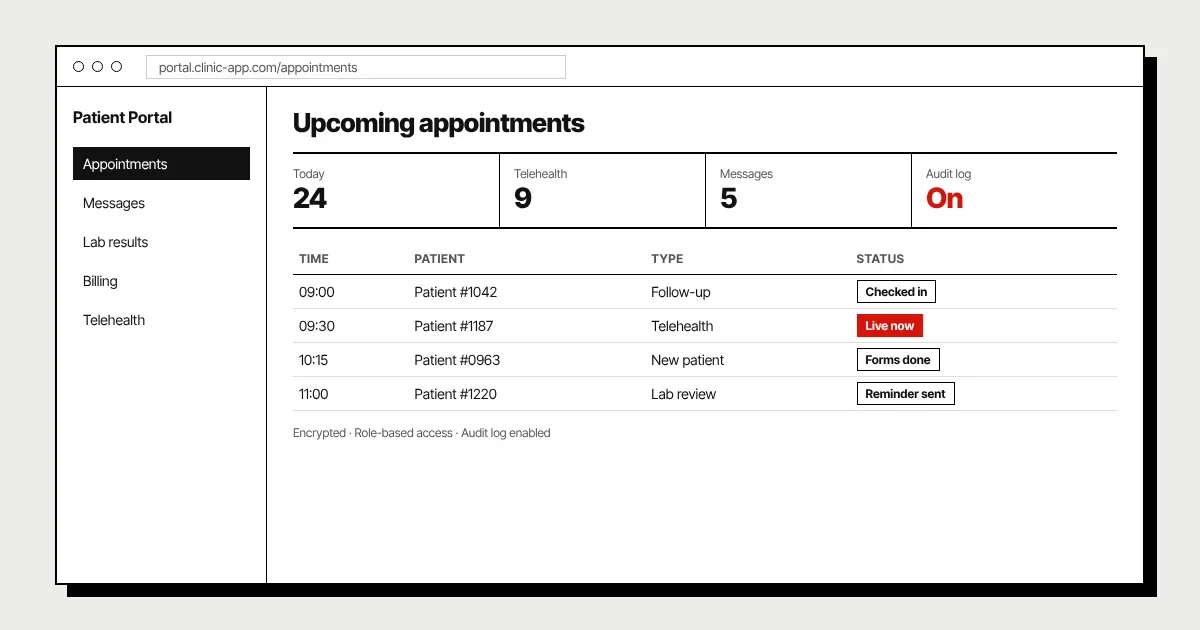
- 01Patient portalsProvide the agreed actions, documents and status information in a controlled patient view. Scope identity checks and any proxy or caregiver access rather than assuming every account represents one adult patient. Keep message routing and response expectations visible to the staff operating the service.
- 02Intake and schedulingCollect only the information needed for the task and validate it before it enters an authoritative record. Connect scheduling with the practice's availability rules and staff review process. Plan errors, duplicate requests and cancellation behavior alongside successful booking.
- 03Telehealth workflowsCustom telehealth software development can connect scheduling, identity, consent workflows and a supported video service. Prepare for connection failure and decide how the practice resumes or redirects a visit. The application must fit provider policies rather than invent clinical escalation or care rules.
- 04Administrative and clinical integrationsExtend existing tools with bounded workflows rather than recreate an entire EHR by default. Show integration status and provide a way to resolve failed or conflicting updates. Custom medical software development needs traceability so staff can understand where data came from and what was changed.
05Compliance & Healthcare Requirements
Compliance & Healthcare Requirements
Applicability depends on the parties, information and services involved. Your privacy, security and legal advisers should determine obligations before the system processes protected information. Requirements affect the deployment and operational process as well as the application code.
- 01HIPAA Privacy and Security RulesThe Privacy Rule addresses protected health information and permitted uses or disclosures, while the Security Rule addresses safeguards for electronic protected health information. Plan appropriate access, risk assessment, auditability and secure handling with the organization responsible for the service. HIPAA custom software development is not a blanket certification of the entire organization. This is general information, not legal advice.
- 02Business associate agreementsWhere a party is acting as a business associate, the required arrangements must be assessed and agreed before relevant information is shared. Review hosting, video and other vendors as well as the development engagement. We do not claim an unconditional BAA policy; roles, access and proposed terms need review for the actual scope. This is general information, not legal advice.
- 03NY SHIELD ActThe SHIELD Act addresses reasonable safeguards for private information within its scope. Map the records collected, limit access and unnecessary retention, and define incident handling with your advisers. Obligations should not be reduced to an encryption checkbox or assumed to disappear because a service provider hosts the application. This is general information, not legal advice.
- 04New York telehealth considerationsProvider authorization, consent, documentation and payer requirements can affect a telehealth workflow. Have the practice confirm applicable New York requirements for the services and patients involved before those rules are implemented. A video connection does not by itself establish that care, reimbursement or the workflow meets the relevant requirements. This is general information, not legal advice.
06Custom Telehealth Software Development & EHR Integrations
Custom Telehealth Software Development & EHR Integrations
EHR and EMR integration depends on the actual platform, permissions and supported interfaces. HL7 messages and FHIR APIs can support healthcare exchange, but the available versions, profiles and workflows must be checked. Epic or another vendor may require registration, approval and access arrangements before development can proceed.
Define the patient identifiers, resource mappings and source of truth with the clinical and technical owners. Test duplicate, delayed and incomplete records and decide how staff reconcile a mismatch. Avoid treating a technically valid API response as proof that the clinical context is correct.
Lab, billing and video connections introduce separate operational and vendor dependencies. Plan authentication, callbacks, retries and failure visibility, with sensitive details kept out of unnecessary logs. Confirm which vendors and environments may handle the data before quoting the complete integration scope.
07How We Build Healthcare Software
How We Build Healthcare Software
Discovery maps the patient and staff journeys, data flows and approval responsibilities before a fixed scope is agreed. Use representative or appropriately de-identified material to test the proposed design. The free discovery call is followed by a fixed quote within 48 hours for the defined work and assumptions.
- 01Design and prototypeReview onboarding, key tasks and error handling with the people operating the workflow. Check permissions and sensitive-data exposure before implementation. A prototype should reveal decisions about staff action and patient expectations, not only screen styling.
- 02Development and QADeliver in two-week sprints with demos of complete journeys and integration behavior. Test authorization, identity mismatches and unavailable dependencies alongside successful actions. Review safeguards with the organization's technical and compliance owners rather than leaving their acceptance to launch week.
- 03Launch and continued operationPlan deployment, training, access and the response to failed workflows with named owners. You own 100% of the custom code, repositories and credentials. Agree monitoring, updates and support responsibilities before the portal becomes a live channel for patients.
08Related services
Related Services
09FAQ
Frequently Asked Questions
We can scope safeguards and workflows that support the applicable HIPAA requirements, with your privacy and security advisers involved. Compliance also depends on contracts, policies, risk assessment and ongoing operation, so an application cannot guarantee it alone. Confirm the parties, data and responsibilities before production use. This is general information, not legal advice.
10Contact
Let's build your software in New York
Book a free 30-minute call. We'll review your idea and give you an honest plan and estimate.
+1 718-883-7253Service area: Brooklyn, Queens & Manhattan, NYC
Hours: Open 24/7